
AI Meets ESG in 2026: Why Sustainability Is Becoming the Next Constraint on Artificial Intelligence
- EcoVision

- Feb 4
- 3 min read
AI’s ESG Moment Has Arrived
In 2026, artificial intelligence is no longer just a productivity story—it is a sustainability issue.
As AI adoption accelerates across finance, manufacturing, healthcare, and consumer platforms, its environmental footprint has moved from the margins of ESG discussions to the center.
Regulators, investors, and civil society are now asking a harder question: can AI scale responsibly in a carbon‑constrained world?
This shift marks a new chapter for ESG, where digital growth and environmental limits are no longer treated as separate conversations.
The Hidden Environmental Cost of Intelligence
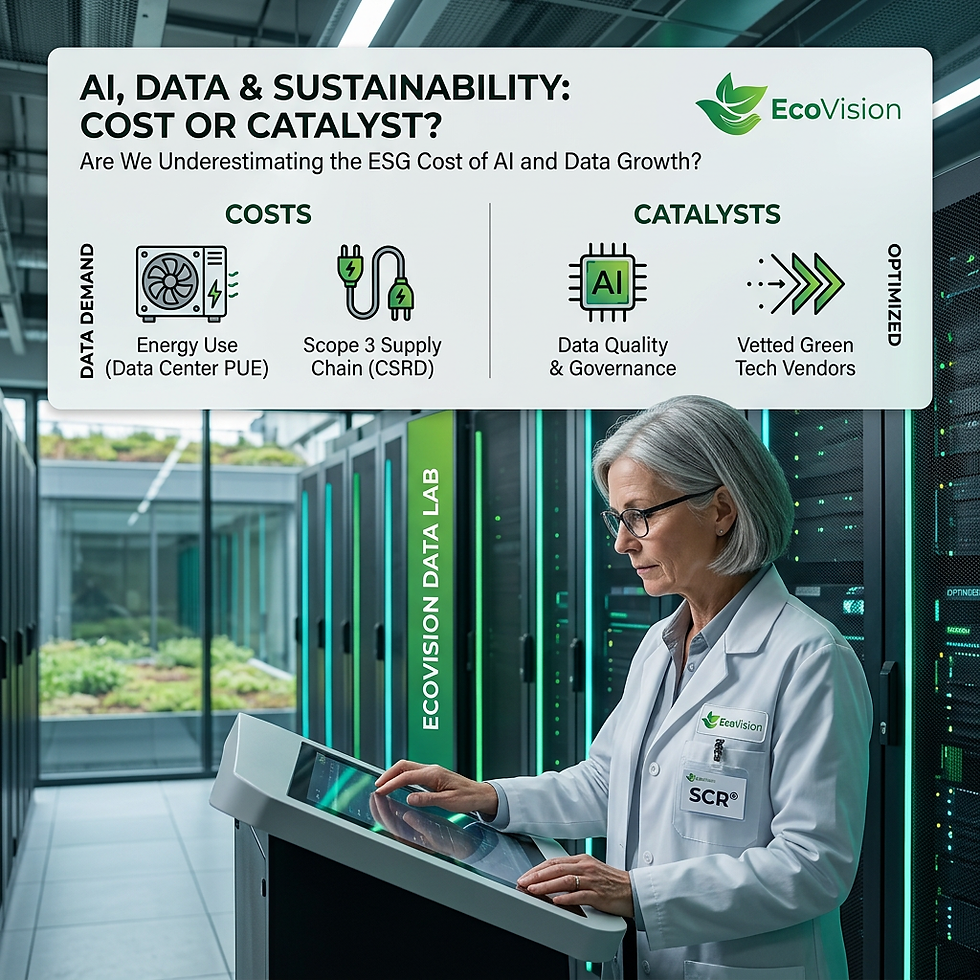
Behind every AI model lies a physical infrastructure footprint—energy‑intensive data centers, water‑cooled servers, and resource‑heavy hardware supply chains.
Recent academic and policy research highlights that current sustainability frameworks were not designed to capture AI‑specific impacts such as lifecycle emissions, water stress, or materials demand from hyper scale data centers.
As a result, AI’s environmental externalities risk being systematically underestimated in corporate ESG disclosures.
This gap is becoming increasingly difficult to ignore as AI workloads grow faster than renewable capacity in many regions.
Why Existing ESG Regulations Are Falling Short
The challenge is not a lack of ESG regulation, but misalignment. Frameworks such as CSRD and CSDDD focus on corporate‑level impacts, while AI’s sustainability risks often sit at the intersection of energy markets, infrastructure planning, and technology design.
Current disclosure requirements emphasize transparency, but offer limited mechanisms to curb absolute environmental impacts or influence where and how AI infrastructure is deployed.
As a result, ESG compliance may improve on paper while real‑world environmental pressure continues to rise.
Investors Are Connecting the Dots
Institutional investors are already responding. A global investor survey released in late 2025 shows that nearly 60% of asset managers are using—or planning to use—AI in sustainability and investment analysis, while simultaneously identifying climate risk as a near‑term financial driver.
More than half report that extreme weather and energy system stress are already influencing capital allocation decisions.
This creates a paradox: AI is both a tool for managing ESG risk and an emerging ESG risk itself.
From Innovation Race to Infrastructure Reality
What is changing in 2026 is tone. The AI conversation is shifting from innovation speed to infrastructure resilience. Governments and regulators are increasingly scrutinizing where data centers are built, how they source energy, and whether water use is compatible with local climate resilience.
Sustainability leaders are now being asked to engage in decisions that were previously left to IT or procurement teams.
AI governance is becoming inseparable from ESG governance.

What Sustainability Leaders Should Focus On Now
For companies deploying AI at scale, the next phase of ESG maturity lies in execution. This includes integrating AI‑related energy demand into climate transition planning, expanding Scope 3 assessments to cover digital supply chains, and improving transparency around data‑center sourcing and efficiency.
It also requires closer collaboration between sustainability, technology, and finance functions—breaking down silos that ESG reporting alone cannot fix.
Those who act early will shape the standards others must eventually follow.
The Strategic Opportunity Hidden in the Risk
Despite the challenges, this moment presents a strategic opportunity. Organizations that align AI deployment with renewable energy procurement, circular hardware strategies, and credible climate targets can turn a potential liability into a competitive advantage.
additional references reading:
ESG Alpha? Some real world corporate examples
As scrutiny increases, credibility—not ambition—will define ESG leadership in the age of artificial intelligence.
In 2026, the question is no longer whether AI belongs in ESG discussions. The question is whether ESG strategies are ready for AI.
References and additional readings
Relevant LinkedIn Hashtags
#ESG#SustainableAI#ResponsibleTechnology#ClimateRisk#DataCenters#CorporateSustainability#ESGStrategy#GreenTech#FutureOfWork#SustainableFinance


Comments