

SAF: Can Aviation Turn Ambition into Scalable Action?-

Why Is Sustainable Aviation Fuel Now a Boardroom Issue?
Sustainable Aviation Fuel (SAF) has moved beyond being a niche aviation conversation. It is rapidly becoming a business, investment and ESG credibility issue for airlines, airports, fuel suppliers, logistics providers and multinational companies with significant travel emissions.
The urgency is real.
Aviation remains one of the harder sectors to decarbonise because long-haul aircraft cannot yet depend on batteries or hydrogen at commercial scale.
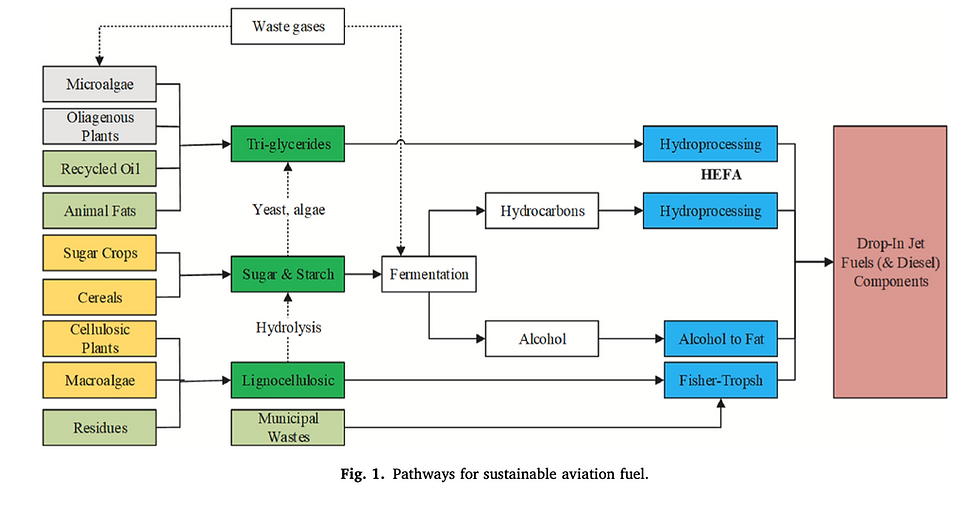
SAF—produced from sustainable waste, residues, biomass or synthetic pathways—offers a practical near-term route to lower lifecycle emissions without replacing today’s aircraft fleet or airport infrastructure.
Yet the central question remains: can supply grow quickly enough, affordably enough and credibly enough?
Is Supply Growing Fast Enough to Meet Aviation’s Climate Commitments?
Progress is visible, but the gap remains enormous.
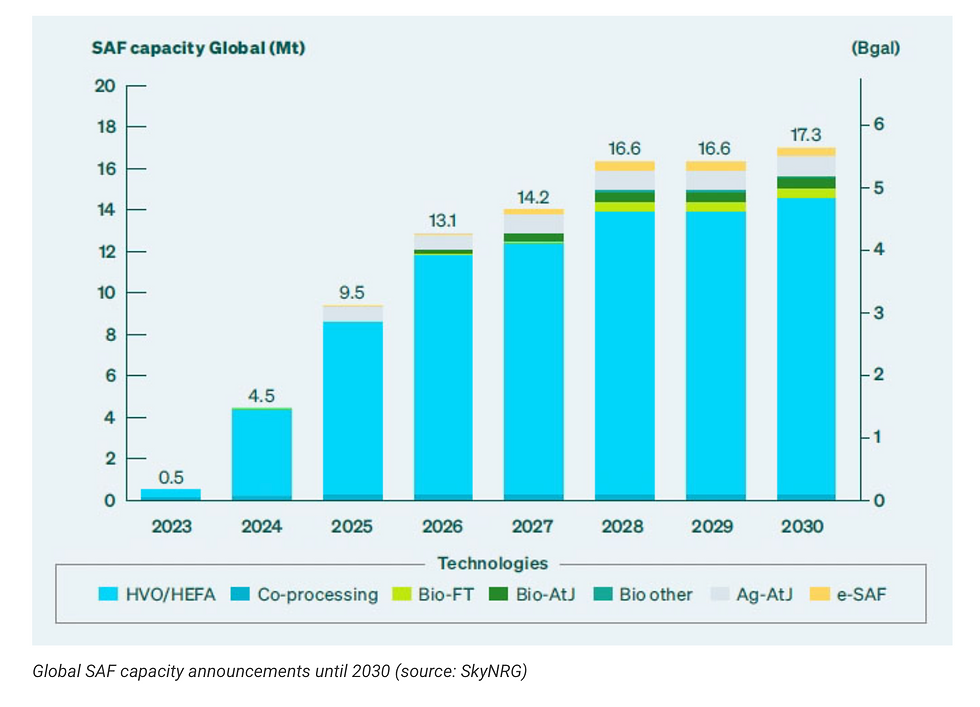
Global SAF production rose from around 1 million tonnes in 2024 to an estimated 1.9 million tonnes in 2025.
For 2026, output is projected at approximately 2.4 million tonnes—still only around 0.8% of global jet-fuel consumption.
Meanwhile, aviation’s net-zero pathway will require SAF volumes on an entirely different scale over the coming decades.
This is not simply a production challenge. It is a feedstock, financing, policy and infrastructure challenge. Sustainable feedstocks are limited, competing industries are seeking the same renewable inputs, and next-generation e-SAF requires abundant low-carbon electricity, green hydrogen and captured carbon.
The transition will not be delivered by airlines alone.
Can SAF Compete When the Green Premium Is Still So High?
Cost remains the industry’s toughest obstacle.
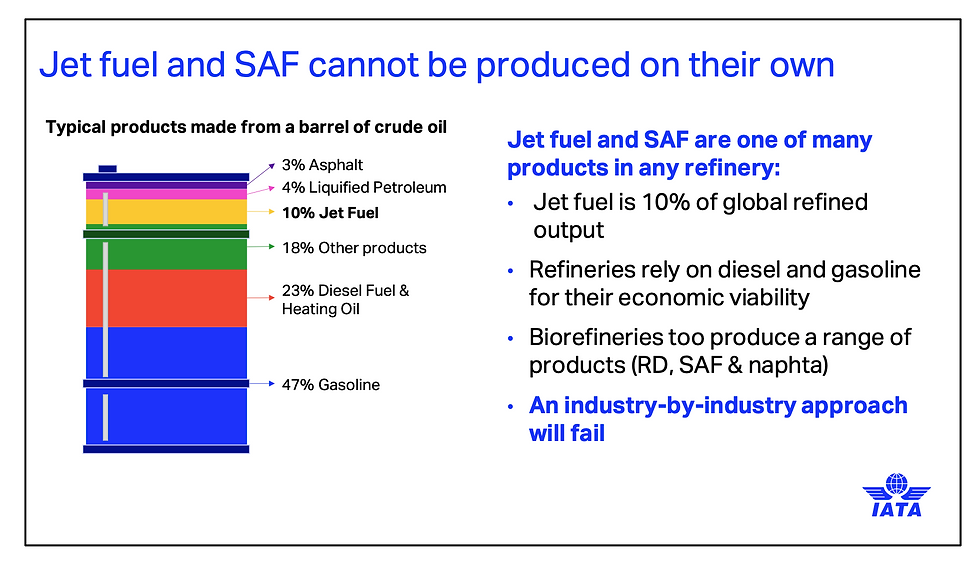
SAF has commonly cost multiple times more than conventional jet fuel, creating a significant “green premium” at a time when airlines already operate in a highly competitive, margin-sensitive environment.
IATA estimates that SAF’s price premium added billions of US dollars to industry fuel costs in 2025.
This is where commercial leadership matters. Long-term offtake agreements, blended-finance structures, production tax incentives, carbon-pricing signals and corporate travel partnerships can help transform SAF from a costly voluntary purchase into a bankable market.
Businesses should view SAF not only as an environmental expense, but as a strategic hedge against future carbon costs, regulatory pressure and customer expectations.
Are Regulations Turning SAF into a Market Reality?
Policy is now reshaping demand.
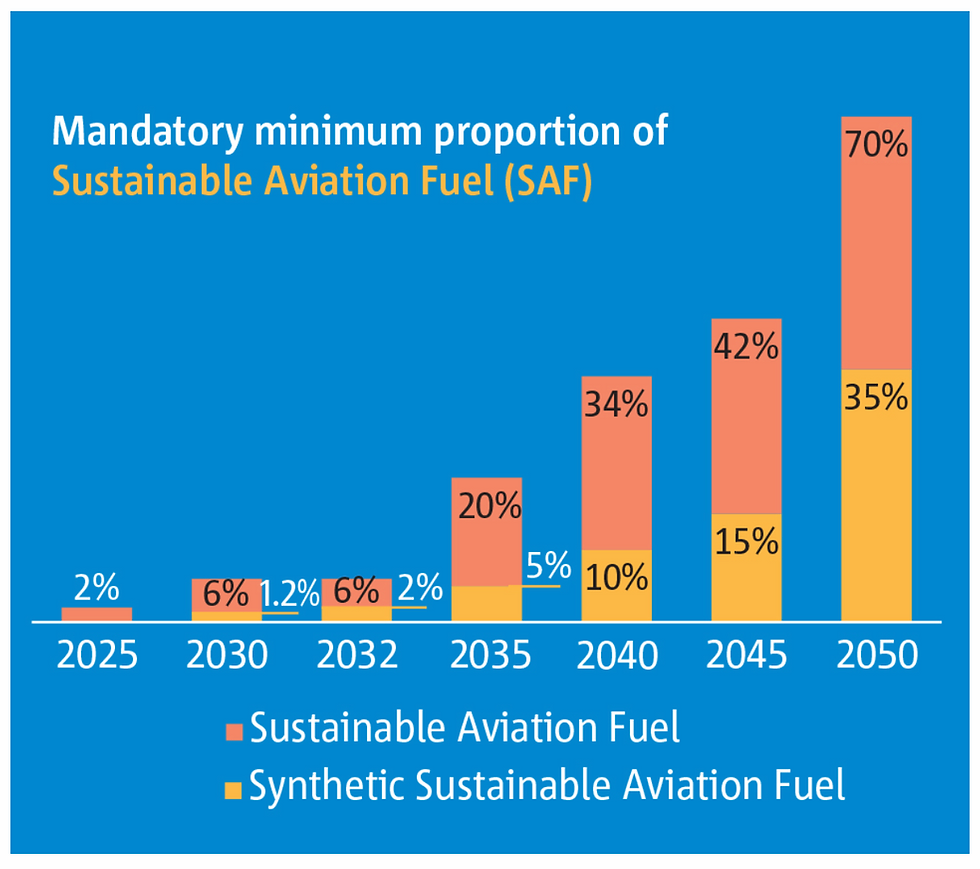
In the European Union, ReFuelEU Aviation introduced a 2% SAF requirement from 2025, increasing to 6% by 2030 and progressing toward 70% by 2050.
The regulation is designed to stimulate supply while creating a more level competitive environment for aviation fuel suppliers and operators.
At a global level, ICAO’s CORSIA framework provides criteria and verification requirements for eligible fuels. This matters because credible SAF claims depend on lifecycle emissions data, sustainability certification and strong controls against double counting.
A lower-carbon fuel claim is only as strong as the evidence behind it.
What Does Credible ESG Disclosure Look Like for SAF?
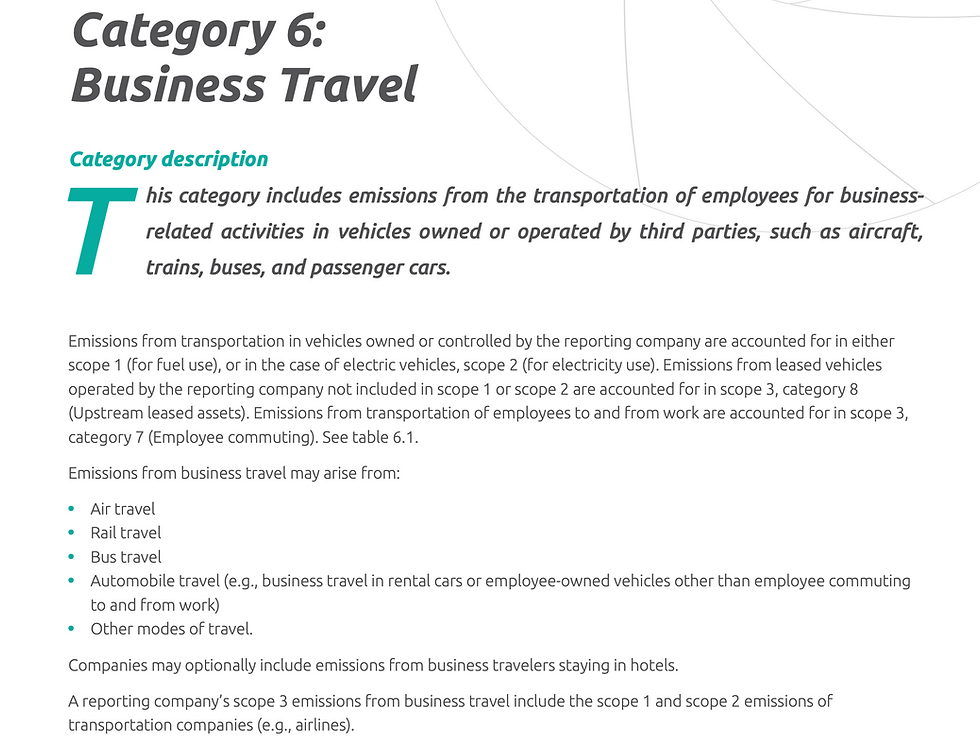
For corporate buyers, aviation emissions are typically part of Scope 3 business-travel emissions.
Under IFRS S2, companies are expected to disclose material climate-related risks, opportunities, targets and Scope 1, 2 and 3 greenhouse-gas emissions using robust measurement approaches.
The standard builds on the TCFD architecture and requires companies to consider industry-based guidance, including SASB Standards.
The practical message is simple: do not report a SAF purchase as a feel-good statistic.
Explain the volume purchased, lifecycle-emissions methodology, certificate or registry approach, claim ownership, financial impact and alignment with the organisation’s transition plan.
Transparency will distinguish genuine climate action from attractive marketing.
Where Are Businesses Showing What Collaboration Can Achieve?
The most promising developments are increasingly collaborative.
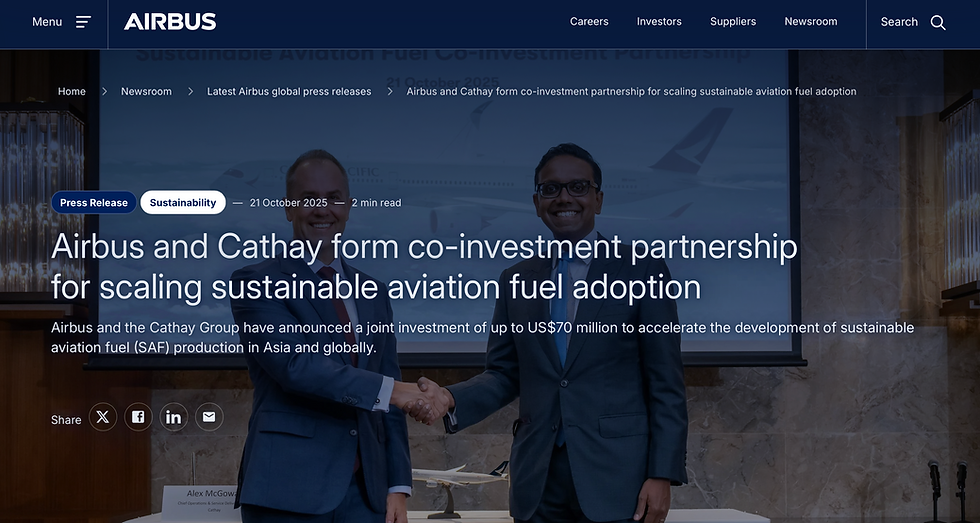
Airbus and Cathay announced a co-investment partnership of up to US$70 million to help scale SAF projects in Asia and globally.
In France, Technip Energies, Airbus, Safran and Tereos formed a joint venture in June 2026 to develop a large-scale SAF project in Dunkirk—linking industrial capability, feedstock expertise and potential offtake demand.
These examples show the direction of travel: the winners will not merely buy SAF when available. They will help build the ecosystem that makes it available.
SAF is difficult, expensive and imperfect—but it is also essential.
The opportunity is not to wait for the perfect fuel. It is to create the partnerships, governance and investment confidence that allow sustainable aviation to take off.
References and Additional Readings:
https://www.sciencedirect.com/science/article/pii/S0965856426002089
https://www.iata.org/en/pressroom/2025-releases/2025-12-09-04/
https://theicct.org/unpacking-the-role-of-sustainable-aviation-fuels/
https://www.easa.europa.eu/en/domains/environment/eaer/sustainable-aviation-fuels
https://www.easa.europa.eu/en/domains/environment/eaer/sustainable-aviation-fuels/saf-policy-actions
https://ghgprotocol.org/sites/default/files/2022-12/Chapter6.pdf

Comments