

EFDB? Emission Factor Database

Updated: Feb 7
Emission Factor Database (EFDB) is an essential tool in carbon accounting and auditing. Let’s me give you some ideas:

What Is the Emission Factor Database (EFDB)?
The EFDB is a global reference database of emission factors — values used to estimate the amount of greenhouse gas (GHG) emissions released from specific activities or energy use.
It is maintained by the Intergovernmental Panel on Climate Change (IPCC) to support consistent and transparent GHG inventories around the world.
Purpose of the EFDB
To provide standardized emission factors for calculating GHG emissions.
To enhance accuracy and comparability between countries, industries, and organizations.
To help nations and companies develop reliable carbon inventories for climate reporting (e.g., under the Paris Agreement).
What Is an Emission Factor (EF)?
An Emission Factor is a coefficient that links an activity to the amount of GHG emitted.
Simple Formula: Emissions (CO₂e) = Activity Data × Emission Factor
Example:
If burning 1 liter of diesel emits 2.68 kg CO₂e, the emission factor for diesel = 2.68 kg CO₂e/L.
So, if a vehicle uses 1,000 liters, then:
1,000 L × 2.68 = 2,680 kg CO₂e
🧾 Contents of the EFDB
The IPCC’s EFDB includes emission factors for:
Category | Example Sources | Common Gases |
Energy | Coal, oil, natural gas, transport fuels | CO₂, CH₄, N₂O |
Industrial Processes | Cement, steel, chemicals | CO₂, HFCs, PFCs |
Agriculture | Livestock, fertilizer use, rice cultivation | CH₄, N₂O |
Waste | Landfills, wastewater | CH₄, N₂O |
Land Use & Forestry (LULUCF) | Deforestation, reforestation | CO₂ |
🌐 Where to Access the EFDB
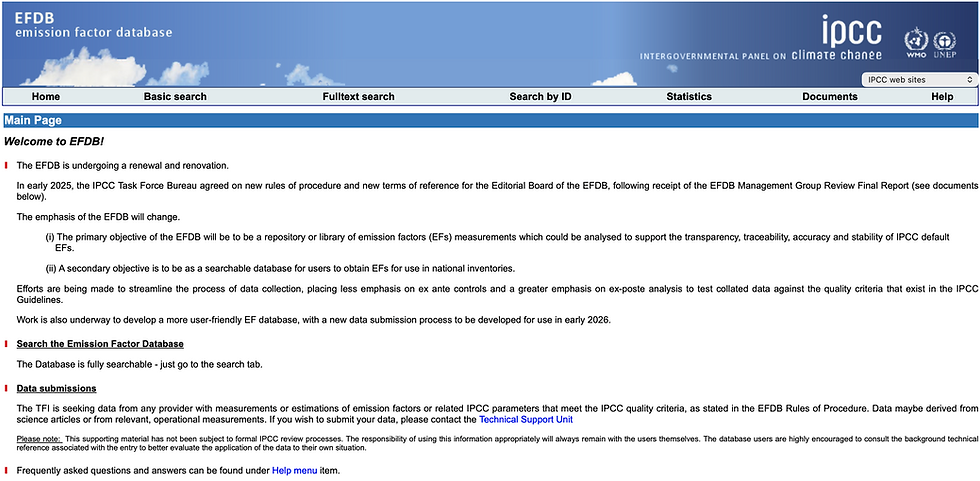
Official Website: https://www.ipcc-nggip.iges.or.jp/EFDB/
Hosted by the IPCC Task Force on National Greenhouse Gas Inventories (TFI).
It’s freely available — searchable by sector, activity, gas, region, and data source.
You can search, view, and download emission factors without any login or payment.
On the site you can:
Browse by sector (energy, waste, agriculture, etc.)
Filter by region or country
Find data sources and references for each emission factor
⚠️ Note
While EFDB itself is free, some third-party carbon accounting tools or software platforms that use EFDB data may charge service fees — but that’s for their tool, not the database.
The IPCC’s own EFDB site remains 100% open-access.
🧠 Why It’s Important
Reason | Description |
Consistency | Ensures all users calculate emissions using recognized methods. |
Credibility | Improves transparency and comparability in GHG reports. |
Compliance | Used by governments for official UNFCCC reporting. |
Accuracy | Uses peer‑reviewed and verified scientific data. |
💡 Example Use‑Case
A company performing a carbon audit can use EFDB to:
Look up emission factors for its country and sector (e.g., electricity in Japan).
Multiply by consumption data (e.g., kWh, liters of fuel).
Calculate and report GHG emissions accurately.
✅ Quick Summary
Term | Meaning |
EF | Numerical value linking activity to emissions |
EFDB | IPCC database of global emission factors |
Use | Estimating GHG emissions for inventories and audits |
Access | Free online at the IPCC website |



Comments