

Green Bond Principles (GBP) : What They Are—and Why They Matter More Than Ever

Green Bond Principles (GBP) are voluntary guidelines that help issuers raise debt financing specifically for environmentally beneficial projects while giving investors a clearer view of where the money goes.
Published by the International Capital Market Association (ICMA), the GBP are widely treated as the market’s shared “rulebook” for green bond credibility—especially at a time when stakeholders are more alert to greenwashing risk.

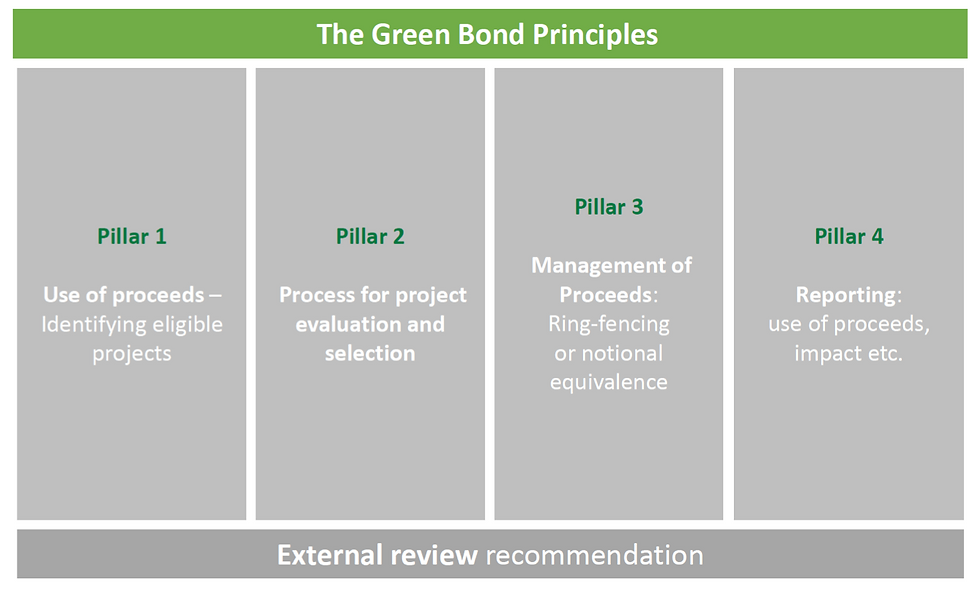
The Four Core Pillars of the Green Bond Principles (GBP)
At its core, the GBP asks issuers to do four things well.
First, use of proceeds: the bond’s funds should be earmarked for eligible green projects (for example, renewable energy, energy efficiency, clean transportation, pollution prevention, sustainable water, climate adaptation, biodiversity, and green buildings).
Second, project evaluation and selection: the issuer should explain how projects qualify as green, what environmental objectives they support, and how material risks (including social or governance risks) are identified.
Third, management of proceeds: issuers are expected to track funds in a transparent way—commonly via internal systems, sub-accounts, or formal allocation methods.
Fourth, reporting: issuers should provide ongoing updates, typically covering allocation of proceeds and, when feasible, environmental impact metrics (e.g., CO₂ avoided, energy saved, renewable capacity installed).
Why GBP Is a Practical “Trust Framework” for ESG Markets
GBP does not replace regulation,
and it is not a guarantee of impact quality. Still, it plays a key market role: it standardizes disclosure expectations so investors can compare deals more easily.
As climate finance grows—and scrutiny follows—issuers increasingly use GBP-aligned frameworks plus external reviews to defend credibility with ratings agencies, lenders, and long-term shareholders (ICMA, 2021).

What a Real Corporate Green Bond Looks Like: Apple
A frequently cited corporate example is Apple, which has issued green bonds to support projects such as renewable energy, low-carbon product design, and greener supply chain initiatives.
What makes this instructive is not “brand halo,” but process: Apple has published allocation and impact reporting that maps spending categories and outcomes, which aligns with the GBP’s emphasis on proceeds tracking and transparency (Apple, 2023).
For corporate treasuries, this shows the green bond is not marketing copy—it is a financing tool that creates reporting obligations and investor expectations.

Another Corporate Example: Siemens and “Industrial Decarbonization” Finance
Companies like Siemens have issued green bonds linked to categories such as energy-efficient technologies and clean transportation-related infrastructure.
This is useful in today’s debate about transition finance: many high-impact emissions reductions come from industrial efficiency, grid modernization, and electrification technologies.
GBP-aligned green bonds can help fund these “enabling” investments—provided the issuer is clear about eligibility criteria and impact measurement.

The Hot Issue: Green Bonds vs. Greenwashing—Where Credibility Is Won or Lost
The market conversation now centers on credibility: a green label is not enough.
Investors want to see (1) strong project eligibility definitions, (2) credible external review, and (3) impact reporting that is not selective.
That is why many issuers seek Second-Party Opinions and align their frameworks with taxonomies or science-based decarbonization logic.
The OECD has also highlighted that credibility and comparability of sustainable finance claims are central to scaling capital for climate goals.
A helpful way to think about it:
GBP is the minimum structure; issuer integrity is the differentiator.
When reporting is thin, or proceeds are vaguely defined, the reputational risk can outweigh the financing benefits—especially for consumer-facing brands.
What Investors and ESG Leaders Should Watch For
If you are reading a green bond announcement, look for three signals:
Clarity: Are project categories specific and defensible?
Controls: Is there a clear method for tracking allocations?
Consequences: Is impact reporting measurable and repeated over time?
These are not academic details; they are what determine whether a green bond supports climate outcomes—or becomes a headline risk.
Closing Thought: GBP as the “Common Language” of Green Capital
Green bonds are evolving from “nice-to-have ESG optics” into a mainstream funding channel, but only if trust scales with issuance.
The Green Bond Principles remain the market’s shared language—helping issuers communicate discipline and helping investors test credibility with a consistent lens (ICMA, 2021).



Comments