
Is SBTi 2.0 the Turning Point for Credible Net-Zero?
- EcoVision

- Jul 18
- 3 min read
Why Is SBTi Version 2.0 Gaining Immediate Boardroom Attention?
The launch of the Science Based Targets initiative (SBTi) Corporate Net-Zero Standard Version 2.0 in July 2026 signals more than a technical update—it reflects a market-wide reset on credibility.
With over 10,000 companies globally now committed to science-based targets, scrutiny from investors, regulators, and stakeholders has intensified.
In parallel, frameworks like ISSB (IFRS S2) and TCFD are pushing climate disclosures into financial materiality. SBTi 2.0 steps in as the operational backbone—turning ambition into measurable, verifiable action.

What Has Fundamentally Changed from Version 1.0?
Unlike its predecessor, Version 2.0 introduces a structured, end-to-end lifecycle approach—spanning governance, base year assessment, target setting, implementation, reporting, and ongoing emissions responsibility.
The shift is clear: from target-setting to accountability.
A notable upgrade is the introduction of company categorization (Category A and B), tailoring expectations based on size, geography, and emissions profile.
Larger companies now face stricter Scope 3 requirements and post-2035 carbon removal obligations—closing long-criticized gaps in value chain accountability.


Are We Seeing a Stronger Push on Scope 3 and Real Economy Impact?
Absolutely—and this is where SBTi 2.0 becomes transformative.
Scope 3 emissions, often representing over 70% of a company’s footprint, are no longer treated as secondary.
Companies are now required to set clearer alignment targets across supply chains, including supplier engagement, product lifecycle design, and even end-of-life circularity.
This aligns closely with emerging frameworks like TNFD and GRI 305, where value chain transparency is becoming non-negotiable. The introduction of “alignment targets” (e.g., increasing the share of low-carbon suppliers or products) reflects a shift from internal decarbonization to ecosystem transformation.


How Does Version 2.0 Strengthen Implementation Credibility?
One of the most practical advancements is the “implementation hierarchy”—prioritizing direct emissions reduction before relying on indirect or market-based mechanisms.
This addresses growing concerns around greenwashing.
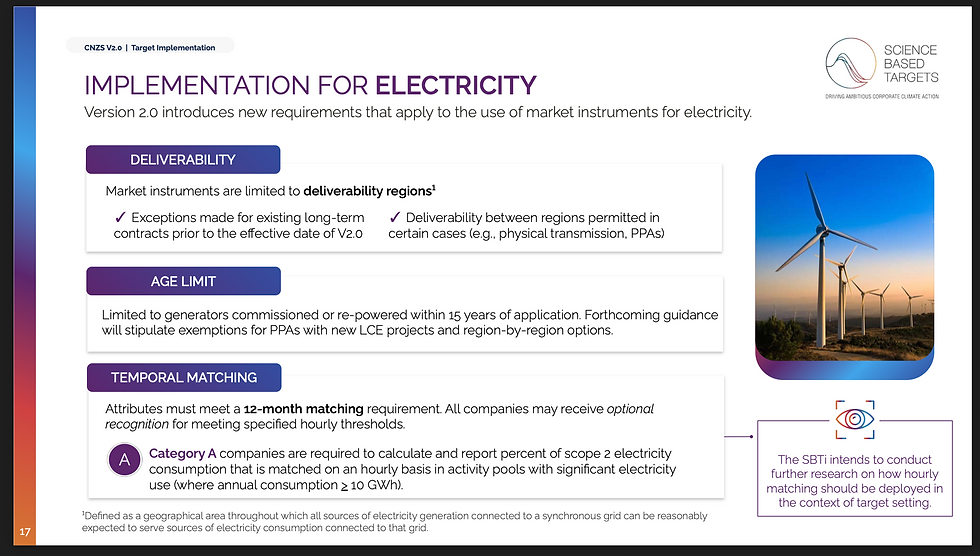
In addition, new rules around electricity procurement—such as deliverability, temporal matching, and generator age limits—bring tighter integrity to Scope 2 claims.
For example, companies must increasingly demonstrate hourly matching of renewable electricity in high-consumption operations, a concept gaining traction in advanced markets like the EU and US.
What Role Do Governance and Transition Planning Now Play?
Governance is no longer a supporting function—it is central.
SBTi 2.0 explicitly requires board-level accountability, documented transition plans, and periodic performance reviews.
This mirrors regulatory trends seen in ISSB, where governance disclosures are mandatory, and in jurisdictions like the EU under CSRD.
Companies must now demonstrate not only “what” their targets are, but “how” they will realistically achieve them—bridging the gap between sustainability teams and financial decision-makers.

Are There Real Business Cases Leading the Way?
Yes—and they are setting the pace. Global leaders in sectors like steel, energy, and consumer goods are already piloting asset-level decarbonization strategies and supplier alignment programs.
For instance, major manufacturers are shifting procurement toward low-carbon steel and cement, while tech firms are investing heavily in 24/7 renewable energy matching.
These moves are not just environmental—they are strategic.
According to recent market analysis, companies with credible transition plans are seeing stronger capital access and up to 20% lower cost of capital, as investors increasingly price in climate risk.

What Should Companies Do Next in This Transition Window?
The transition timeline is deliberately phased—Version 2.0 becomes operational in 2027 and mandatory by 2028.
This gives companies a critical window to assess readiness.
Organizations should begin by strengthening their GHG inventory in line with the GHG Protocol, aligning disclosures with ISSB or TCFD, and stress-testing their current targets against the new requirements.
Early movers will not only reduce compliance risk but also position themselves competitively in an increasingly ESG-driven market.
Is SBTi 2.0 the New Benchmark for Net-Zero Integrity?
In many ways, yes. SBTi 2.0 reflects a broader market evolution—where ambition alone is no longer enough.
The focus is shifting to credibility, transparency, and real-world impact.
For businesses, the message is clear: net-zero is no longer a pledge—it is a performance metric.



Comments