

SBTi - Science Based Targets initiative

Updated: Feb 2
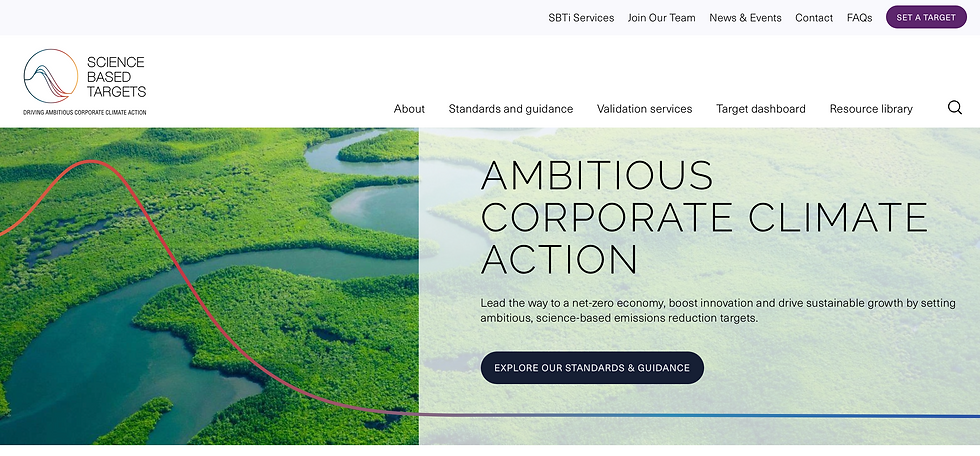
What Is SBTi?
SBTi (Science Based Targets initiative) is a global framework that helps companies set greenhouse‑gas (GHG) reduction targets that are aligned with climate science — specifically, with the goals of the Paris Agreement to limit global warming to 1.5 °C above pre‑industrial levels.
SBTi was co‑founded by CDP, UN Global Compact, WRI, and WW
Launched in 2015, SBTi is a collaboration among:
CDP (formerly Carbon Disclosure Project)
United Nations Global Compact (UN GC)
World Resources Institute (WRI)
World Wide Fund for Nature (WWF)
🎯 Core Purpose of SBTi
It ensures that corporates and financial institutions:
Quantify emission‑reduction targets scientifically (rather than arbitrarily);
Align business models with net‑zero transition pathways;
Gain stakeholder trust that their climate commitments are real, measurable, and Paris‑aligned.
Put simply:
SBTi translates climate goals into measurable, science‑backed emission targets that can be independently validated.
💡 How It Works — The SBTi Process
Step | Description |
1. Commit | The company publicly commits to setting a science‑based target (SBT). |
2. Develop | Use SBTi calculation tools (linked to IPCC carbon budgets) to design reduction targets covering Scope 1, 2, and sometimes 3 emissions. |
3. Submit for validation | SBTi reviews methodology and confirms alignment (1.5 °C or “well below 2 °C” scenario). |
4. Announce & disclose | Company publicly announces approved target; appears on the SBTi registry. |
5. Implement & report | Monitor progress through annual ESG/ climate disclosures. |
Typical commitment timeframe: 5 – 15 years reduction horizon, often aiming for net‑zero by 2050.
🌱 Relationship with ESG Frameworks
SBTi relates directly to the “E” (Environmental) dimension of ESG — particularly climate strategy, emissions, and risk management.
Here’s how it connects to prominent ESG reporting and disclosure frameworks:
ESG / Sustainability Framework | SBTi Impact / Integration |
TCFD (Task Force on Climate‑related Financial Disclosures) | SBTi targets provide quantitative evidence for TCFD’s “Metrics and Targets” pillar. |
ISSB / IFRS S2 (Climate Standard) | SBTi data supports disclosure of Scope 1‑3 emissions and transition plans consistent with IFRS S2 mandates. |
GRI 305 (Emissions) | SBTi validated targets serve as credible emissions reduction benchmarks under GRI reporting. |
UN Sustainable Development Goals (SDG 13: Climate Action) | SBTi targets directly advance SDG 13 and related SDGs 7 (energy) & 12 (consumption). |
CDP Questionnaire | Companies with SBTi‑approved targets score higher on climate leadership and transparency. |
In essence:
SBTi gives ESG reports climate depth and credibility — transforming climate talk into quantifiable, science‑verified commitments.
⚙️ Strategic Impact on ESG Practices
Impact Area | Effect of Adopting SBTi |
Governance | Boards must oversee measurable climate objectives → stronger “G” integration. |
Strategy | Aligns long‑term business models with low‑carbon transition → part of TCFD/ ISSB disclosures. |
Risk Management | Reduces transition risk (e.g., carbon pricing, regulation, supply chain). |
Metrics & Targets | Provides robust, auditable key metrics → strengthens ESG credibility for investors. |
Investor Perception | SBTi validation signals seriousness → better ESG ratings and financing opportunities (green bonds, sustainability‑linked loans). |
📊 Hong Kong & Regional Context
Many major Hong Kong‑listed enterprises (e.g. CLP, Swire Pacific, Hong Kong & China Gas, Hang Seng Bank) have adopted SBTi‑validated targets, driven by:
HKEX ESG Reporting Code (Appendix 27) requiring climate‑risk disclosure and emissions data;
SFC & TCFD alignment policy pushing for physical/ transition risk reporting;
Global capital markets and investor pressure for Paris‑aligned climate strategies.
🔍 Quick Summary
SBTi | ESG Framework Relationship | |
Nature | Science‑based carbon‑target‑setting standard | Supports and strengthens ESG environmental disclosures |
Focus | GHG reduction targets (Scopes 1–3); net‑zero pathways | Environmental pillar: climate & resource management |
Validation body | Science Based Targets initiative | Used within ESG frameworks (TCFD, GRI, ISSB, HKEX ESG Code) |
Output | Verified emissions reduction targets aligned with 1.5 °C | Provides quantitative metrics and improves ESG ratings |
Impact | Enhances credibility, transparency, and investor confidence | Central tool in climate and sustainability strategy |
SBTi is the scientific backbone behind credible climate target‑setting, and it bridges ESG disclosure with real emissions performance — turning environmental promises into measurable, Paris‑aligned action.



Comments