

Geoengineering? Pros & Cons?

Updated: Feb 14
Geoengineering refers to large‑scale, intentional technological interventions designed to modify the Earth’s climate system in order to reduce global warming or offset the impacts of climate change.

Two main types, SRM & CDR:
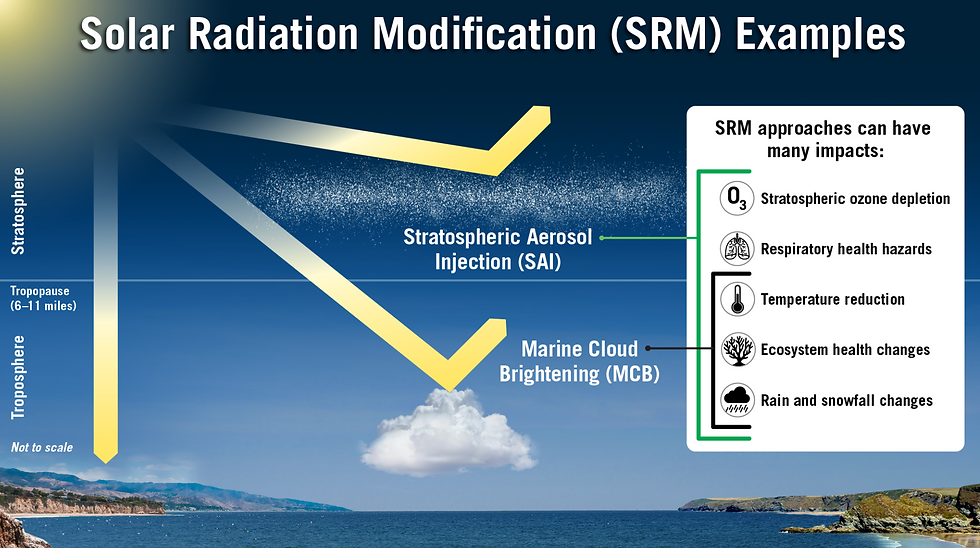
Type 1: Solar Radiation Management (SRM)
Goal: Reflect a small portion of sunlight away from Earth back into space so the planet cools.
Examples:
• Stratospheric aerosol injection – spraying tiny reflective particles into the upper atmosphere.
• Marine cloud brightening – making ocean clouds whiter so they reflect more sunlight.
• Space-based reflectors – mirrors in space (theoretical).
Pros: Quick temperature‑cooling effect.
Cons: Does NOT reduce CO₂, may cause unpredictable weather, politically risky.
Type 2: Carbon Dioxide Removal (CDR)
Goal: Remove CO₂ from the atmosphere and store it.
Examples:
• Direct air capture – machines that suck CO₂ from the air.
• Afforestation / reforestation – planting trees.
• Bioenergy with carbon capture (BECCS) – grow plants → burn for energy → capture CO₂.
• Enhanced weathering – spreading minerals that absorb CO₂.
Pros: Tackles the root cause (CO₂).
Cons: Slow, expensive, needs huge land and resources.

Why is geoengineering controversial?
• Could change global weather patterns.
• No global agreement on who controls it.
• Some fear it may reduce pressure to cut emissions.
• Long‑term effects are unknown.
Based on the current human technology, still have so many uncertainty and unpredictable behavior related to geoenginnering. Also some of the change can be irreversible and drastic. We also need to consider the ethic and geo-political factors involving...
Why is it being discussed?
Because climate change is accelerating, and traditional solutions alone may not be enough. Geoengineering is seen as a backup or emergency tool, not a replacement for cutting emissions.
Some examples of geoengineering:
1. SPICE Project (UK) – Stratospheric Aerosol Injection (cancelled test)
Purpose:
Test equipment for spraying tiny reflective particles into the stratosphere.
Status: Cancelled due to ethical and governance concerns.
Importance: Highlighted the political risks around SRM.

2. Marine Cloud Brightening (MCB) – Australia & USA
Location: Great Barrier Reef, and earlier tests in California.
Purpose: Spray fine sea salt into clouds to make them whiter and more reflective.
Status: Ongoing small‑scale research.
Goal: Protect corals from heat stress.

3. Iron Fertilization Experiments – Several Countries
Iron is added to ocean water to stimulate plankton growth, which absorbs CO₂.
Notable experiments:
• LOHAFEX (2009) – India + Germany
• SOFeX (2002) – USA
• EIFEX (2004) – European researchers
Results: Mixed; controversial due to ecological risks.
4. Harvard SCoPEx (USA) – Stratospheric Aerosol Experiment
Purpose: Test how reflective particles behave in the atmosphere.
Status: Paused due to public and political concerns.
Planned location: Sweden.Controversy:
Fear of opening the door to full-scale SRM.

5. Iceland CarbFix Project – Carbon Mineralization
Purpose: Inject CO₂ into volcanic basalt rock where it mineralizes into stone.
Status: Successful ongoing project.
Importance: One of the most promising CDR techniques.

References & additional readings:
#Geoengineering #ClimateInnovation #CarbonRemoval #SustainabilityLeadership #ClimateAction #NetZeroSolutions #CleanTechnology #EnvironmentalStewardship #GreenTransition #ClimatePolicy



Comments